The story in 30 seconds
- Dadaji Khobragade spotted three odd rice spikes in a Patel 3 field in Chandrapur in 1983.
- He bred them into HMT, a rice that spread across Vidarbha and later to other states.
- An agricultural university took his seed in 1994 and released PKV-HMT in 1998.
- NIF honoured him in 2005 and 2009 and Forbes listed him in 2010, but his income stayed small.
- He died on 3 June 2018, aged 79, leaving behind nine rice varieties.
In this story4 sections
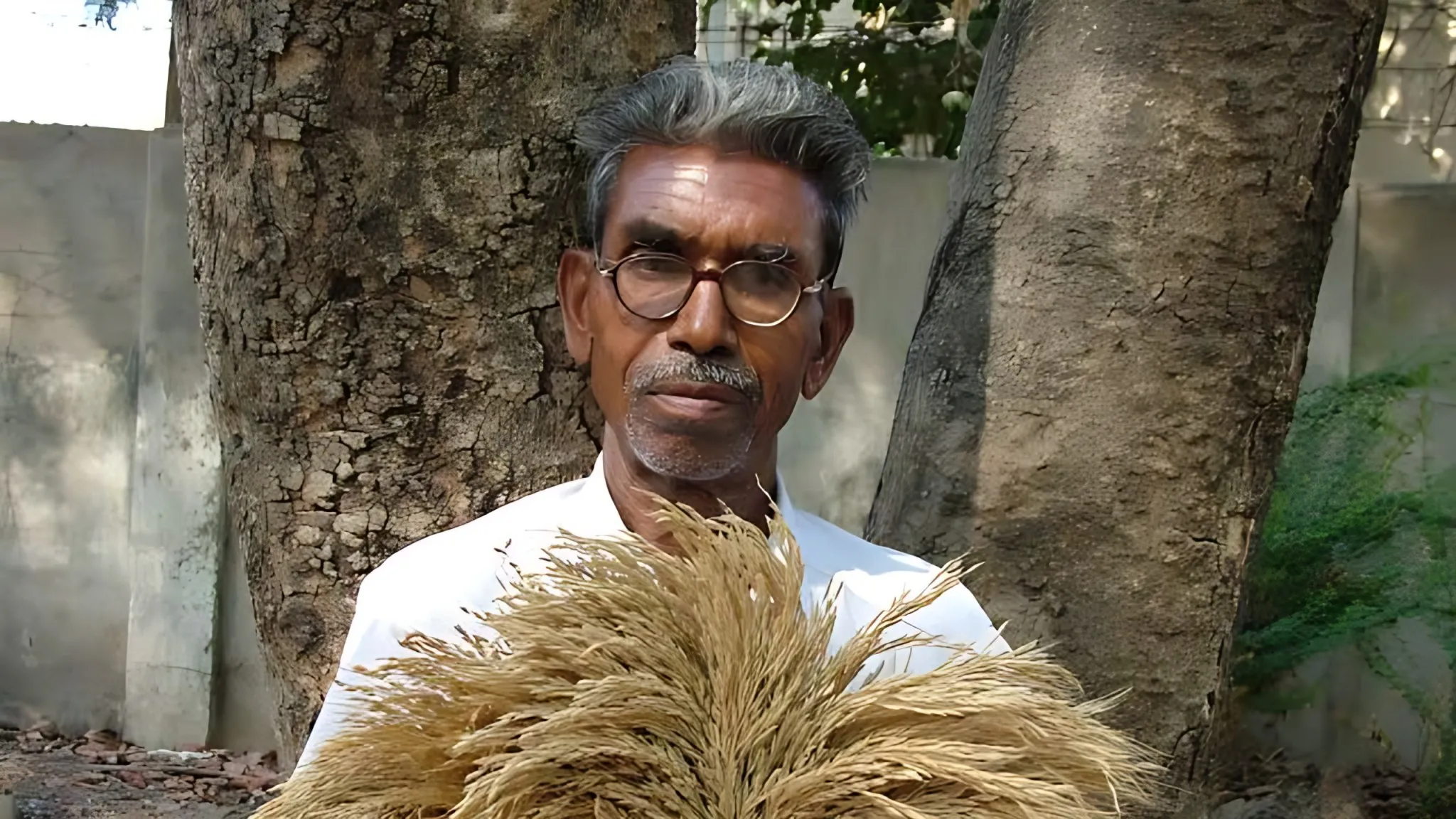
Dadaji Khobragade was growing a field of Patel 3 rice in Nanded village, in Maharashtra's Chandrapur district, in 1983 when he spotted three spikes with yellow seeds that looked different from the rest, according to the National Innovation Foundation (NIF). He sowed their seeds separately from 1984 and kept at it, because they yielded more and tasted better than Patel 3, a variety bred at the agricultural university in Jabalpur, a government record notes.
How Dadaji Khobragade bred HMT rice
He had left school after Class 3 because of family hardship, and he farmed about one and a half acres of his own, NIF recorded. The selection took about five years of work on that small plot, with no help from scientists. In 1988 the self-taught rice breeder sowed 4 kg of the new seed and harvested 400 to 450 kg.
Word spread through local trade. A Nagpur trader bought 40 bags of the seed in 1989, and in 1990 a large landowner bought 150 kg to sow four acres, NIF said. A trader in Talodi named the rice HMT, after the popular watch brand. It had short grains, a mild aroma and good cooking quality, and it fetched better prices, so farmers across Vidarbha took it up. HMT rice was later sold in Andhra Pradesh, Gujarat, Chhattisgarh and Madhya Pradesh as well.
Dadaji Khobragade and PKV-HMT
In 1994, a scientist from the Sindewahi rice station of Dr Panjabrao Deshmukh Krishi Vidyapeeth (PKV), the agricultural university in Akola, took 5 kg of his seed for experiments, journalist Meena Menon wrote in the Economic & Political Weekly. In 1998 the university released a variety called PKV-HMT. Khobragade was not told and his consent was not sought, Menon wrote. PKV accepted that the seed had come from him, but said it had the means to develop a purer strain.
A former rice breeder at Sindewahi told NIF that the farmer had made the original selection, but argued that HMT was a mixture that needed purifying. "Farmers cannot maintain individual plant selections over the years," he said. Khobragade said he could see no difference between the two.
Awards came, money did not
Recognition came slowly. His own village panchayat passed a resolution in 1993 recognising him as a paddy seed producer, NIF noted. NIF itself honoured him in 2005 and 2009, with a token payment of Rs 50,000 for each variety, and Forbes named him in 2010 among India's top seven rural entrepreneurs, Menon wrote. He received more than 100 awards in all. By 2005 he had bred seven more varieties, including Vijay Nanded, Nanded Hira and DRK, named after himself, NIF recorded. Yet that year his annual income was about Rs 12,000, and he sometimes worked as a daily wage labourer.
In 2012 his rice was registered as Dadaji HMT, a name chosen because HMT was a well-known trademark and an application for PKV-HMT had already been filed, Menon wrote. He agreed to the name but was unhappy about it. His DRK variety was registered with the Protection of Plant Varieties and Farmers' Rights Authority in February 2018. Dadaji Khobragade died on 3 June 2018, aged 79, leaving behind nine rice varieties.
Dadaji Khobragade showed that a farmer with one and a half acres and a sharp eye could breed a rice sold across five states. Getting the credit for it, and a share of the money it made, proved much harder.
For more grassroots innovators, read our stories on Arunachalam Muruganantham and Dharambir Kamboj.
More from FoundersFeed: grassroots innovators and founders from Maharashtra.
This is a legacy profile of Dadaji Khobragade, who died in 2018. It is based on the National Innovation Foundation's profile, Meena Menon's account in the Economic & Political Weekly, and a government record, linked above. Reports differ on how many varieties he bred, from eight to eleven; this story uses the NIF count for 2005 and Menon's count at his death. For corrections, write to editorial@foundersfeed.in.
Sources
Questions readers ask
Who was Dadaji Khobragade?
A farmer from Nanded village in Maharashtra's Chandrapur district who bred the HMT rice variety and several others. He died in 2018.
How was HMT rice developed?
In 1983 he spotted three different-looking spikes in a Patel 3 field and kept selecting and sowing their seed for several years.
Why is it called HMT?
A trader in Talodi named it after the HMT watch brand, which was popular at the time.
What is PKV-HMT?
A version released in 1998 by Dr Panjabrao Deshmukh Krishi Vidyapeeth, which said it had purified seed it took from Khobragade in 1994.
What awards did Dadaji Khobragade receive?
NIF honoured him in 2005 and 2009, Forbes listed him in 2010, and he received more than 100 awards in all.

Written by
Sunny PanwarSunny Panwar is Correspondent, Bharat and States, at FoundersFeed. He reports from the ground on state startup policy, founder incentive schemes, incubation hubs and the events where India's founders and investors meet.