The story in 30 seconds
- Sundaram Verma is a farmer from Danta in Rajasthan's Sikar district.
- He stumbled on the one-litre idea in 1985 and spent about ten years testing it.
- The method uses deep ploughing after the monsoon to store moisture, then one litre of water per sapling.
- He had grown about 50,000 trees this way when he was named for the Padma Shri in 2020.
- He has also preserved over 700 seed varieties from 15 major crops.
In this story4 sections
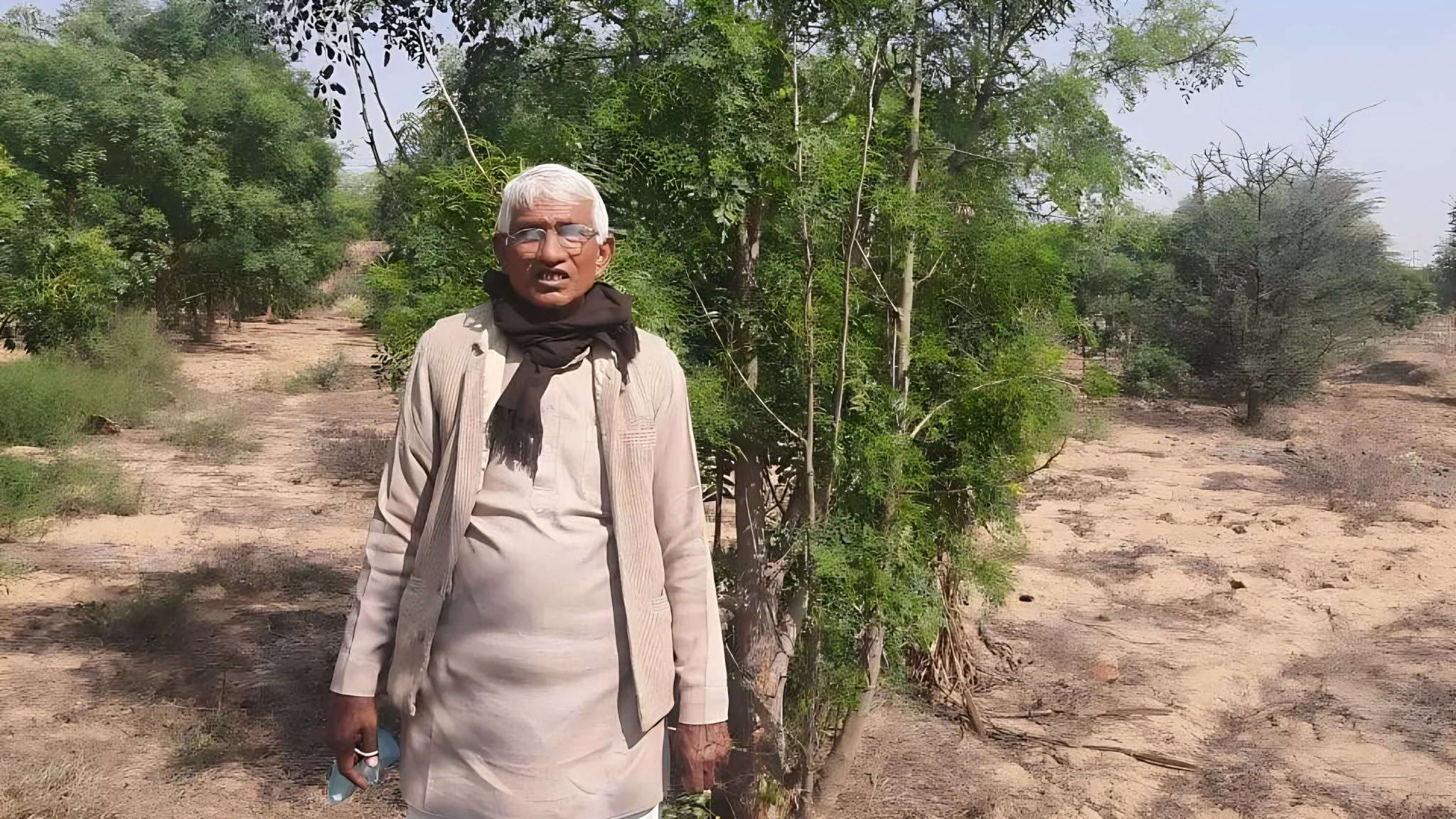
Sundaram Verma, a farmer from Danta in Rajasthan's Sikar district, has spent decades showing that a tree can be raised on dry land with a single litre of water. In January 2020 he was one of five people from Rajasthan named for the Padma Shri, PTI reported. By then he had grown about 50,000 trees with the method in the arid Shekhawati region, ANI reported, and he said the award would help him take the work further.
Sundaram Verma and a family farm in Sikar
Farming runs in his family. His grandfather started it, and as a child he helped his father and uncles in the fields, he told The Better India in 2019. He studied science, and a Krishi Vigyan Kendra later arranged for him to take a two-month course in dryland farming at the Indian Agricultural Research Institute in New Delhi. His family farm covers about 17 acres and grows grains, pulses, fruit and vegetables.
He has said his science training taught him to keep experimenting, and that is what carried him through years of failed attempts, the site reported.
How the one-litre method of Sundaram Verma works
He stumbled on the idea in 1985, when he noticed that some saplings had survived without any watering, and spent about ten years testing it, according to The Better India. He worked out that levelling the field "had broken the capillary movement of water", so moisture stayed in the soil instead of rising and evaporating.
The method uses the monsoon rather than a pipe. First, the land is levelled so rainwater does not run off. Within about a week of the first rain, the field is ploughed roughly a foot deep to clear weeds and break the thin channels that draw water up. A second ploughing just after the rains end locks the remaining moisture into the soil.
A few days later, pits about a foot deep are dug and saplings are planted with their roots at least 20 cm below the surface, with wet mud packed around the base. Each sapling gets one litre of water at planting, and then nothing more. He recommends planting by late September, when cooler weather helps roots go deeper, and weeding every three months to cut evaporation.
On his own farm, 600 pomegranate saplings planted on one hectare about a decade earlier had all survived, he told The Better India in 2019. Saplings that get through their first two weeks, he says, tend to live for the long term.
A method that spread from field to field
Over the years farmers came to see his fields, and the technique spread from village to village, Asianet Newsable reported in December 2025, putting his count at more than 60,000 trees, mostly native species. He has also preserved over 700 seed varieties from 15 major crops suited to Rajasthan's dry regions, and now concentrates on millets, mustard and cotton grown with little water, the report said. Since 2020 he has trained farmers in Rajasthan and other states in the technique, and he shares his work through the Honey Bee Network and the National Innovation Foundation.
The National Innovation Foundation, an autonomous body under the Department of Science and Technology, has supported his work, and he has scouted other grassroots innovators for it. One of them, the cauliflower breeder Jagdish Parikh, received the Padma Shri in 2019, according to the department.
His earlier honours include an international award for agro-biodiversity from Canada's International Development Research Centre in 2007 and National Innovation Foundation awards for scouting in 2005 and 2015, The Better India reported. Sundaram Verma was 68 when the Padma Shri was announced. He still describes himself first as a farmer, Asianet Newsable reported.
For more grassroots innovators, read our stories on Dharambir Kamboj and Arunachalam Muruganantham.
More from FoundersFeed: grassroots innovators and founders from Rajasthan.
This story is based on interviews Sundaram Verma has given to the press, company filings and statements, and news reports, linked above. FoundersFeed did not interview Sundaram Verma for this story. For corrections, write to editorial@foundersfeed.in.
Sources
- The Better India: How Sundaram Verma grows a tree with one litre of water (2019)
- Business Standard (PTI): Five people from Rajasthan honoured with Padma Shri (2020)
- Republic World (ANI): Padma Shri for environmentalist Sundaram Verma (2020)
- Asianet Newsable: How a Rajasthan farmer grew 60,000 trees (2025)
- Department of Science and Technology: Sundaram Verma, grassroots innovator
Questions readers ask
Who is Sundaram Verma?
He is a farmer from Danta in Rajasthan's Sikar district who developed a way to grow trees in dry land with one litre of water each.
How does the one-litre method work?
The field is levelled and ploughed after the first monsoon rain and again when the rains end, to trap moisture in the soil. Saplings are then planted with deep roots and given one litre of water once.
When did Sundaram Verma receive the Padma Shri?
He was named for the Padma Shri in January 2020.
How many trees has he grown?
About 50,000 by 2020 and more than 60,000 by late 2025, according to reports.
Has anyone backed his work?
The National Innovation Foundation, under the Department of Science and Technology, has supported him, and he scouts other grassroots innovators for it.

Written by
Sunny PanwarSunny Panwar is Correspondent, Bharat and States, at FoundersFeed. He reports from the ground on state startup policy, founder incentive schemes, incubation hubs and the events where India's founders and investors meet.