The story in 30 seconds
- A 1969 road accident shattered D.R. Mehta's right thigh bone into 43 pieces; doctors saved the leg.
- In hospital in Jaipur he met the surgeon and craftsman behind the low-cost Jaipur Foot.
- In 1975 he set up BMVSS to fit the foot and other aids free for people who cannot pay.
- BMVSS says it has helped about 2.5 million people, with 37 centres in India and camps in 42 countries.
- Four in five Indians with limb disabilities still go without a prosthesis, mostly because of cost.
In this story5 sections
In January 1969, the collector of Jaisalmer was driving to Pokhran when his car crashed. Devendra Raj Mehta's right thigh bone was shattered into 43 pieces, and doctors in Jodhpur considered amputating the leg, The Federal reported. They saved it, and he spent the next five months recovering at Sawai Man Singh Hospital in Jaipur.
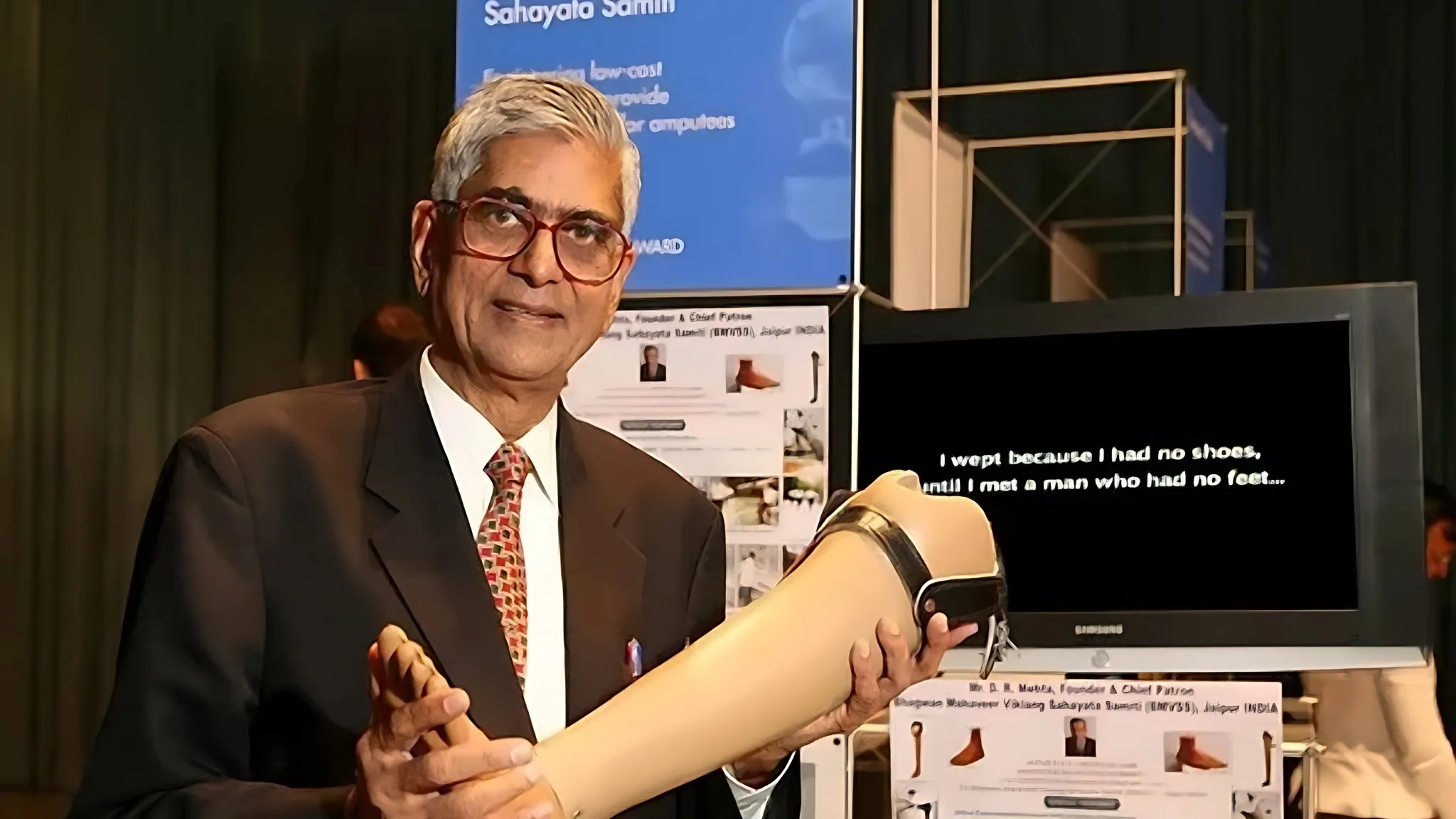
At the hospital he met two men who had just built something new: Pramod Karan Sethi, an orthopaedic surgeon, and Ram Chandra Sharma, a sculptor turned craftsman. Together they had designed a cheap artificial foot that let wearers walk on rough ground and squat. Six years later, in 1975, Mehta set up Bhagwan Mahaveer Viklang Sahayata Samiti (BMVSS) in Jaipur to fit that foot free for people who could not pay.
Fifty years on, BMVSS says it has helped about 2.5 million people with artificial limbs, calipers and other aids, in India and in camps abroad. Mehta, who later served as chairman of SEBI, the markets regulator, is still its founder and chief patron.
A leg that was saved
Mehta has always tied the charity to his own luck. His leg was broken in 43 places, he told Gulf News, and he got the best treatment available, so the leg was saved. After he recovered, he told The Federal, he wanted to do something for poor patients.
BMVSS was registered as a society in Jaipur on 29 March 1975, according to the organisation's own brochure. It started with a corpus of ₹4 lakh, The Federal reported. The model has stayed simple: patients can walk in without an appointment, are measured and fitted on site, and pay nothing.
A foot built for Indian lives
The Jaipur Foot was developed in 1968 at SMS Medical College in Jaipur by a group of doctors and a master craftsman, Tata Trusts' Horizons magazine reported in April 2026. It is the only prosthetic foot without a hinged ankle that lets users walk or run on uneven ground, swim and squat.
It is also cheap. A BMVSS prosthesis costs about ₹2,500 to ₹5,000 to make, against ₹1 lakh to ₹5 lakh for prostheses in developed countries, according to Tata Trusts. Most patients need about three hours for a fitting and go home within one to three days, The Federal reported.
Uptake was slow at first. Only about 50 limbs were fitted in the foot's first seven years, Tata Trusts reported. BMVSS later worked with Stanford University on a knee joint: the Stanford-Jaipur knee, unveiled in 2009, was named one of Time magazine's best inventions of that year and has since been fitted on more than 30,000 patients.
How it pays for free limbs
A large share of BMVSS's money comes from government institutions, The Federal reported, with donors including the Sir Dorabji Tata Trust, Azim Premji Foundation, Nomura and Deutsche Bank. Administrative and overhead costs are 3.6% of its spending. Mehta describes the work as help, not charity.
The organisation now runs 37 centres in India and helps about 300 people a day. In the year to August 2025, it supported about 1.78 lakh people with limbs, calipers, tricycles, wheelchairs, hearing aids and other aids, Mehta told PTI, as ThePrint reported. It has also held about 120 camps in 42 countries, including Afghanistan, Iraq and Rwanda.
The gap that remains
The need is still far larger than the supply. About 10 million Indians have locomotor disabilities, and as many as four in five people with limb disabilities do not get a prosthesis or assistive device, mainly because of cost, Tata Trusts reported. About 75% of people with disabilities live in rural areas, far from fitting centres.
That is why BMVSS is leaning on camps. Tata Trusts is funding camps in Bihar, Jharkhand, Maharashtra, Uttarakhand and Uttar Pradesh from September 2025 to March 2027, aimed at about 18,000 people. In July 2026, BMVSS signed agreements with the Uttar Pradesh government and Dr Shakuntala Misra National Rehabilitation University on disability support, ThePrint reported.
Speaking to The Federal as BMVSS marked 50 years, Mehta talked about the joy of watching people walk again on limbs they never paid for. "That joy will keep BMVSS going for at least another 50 years," he said.
More from FoundersFeed: health impact stories, health founders and founders from Rajasthan.
This story is based on interviews D.R. Mehta gave to The Federal, Gulf News and PTI, BMVSS material and news reports, linked above. FoundersFeed did not interview D.R. Mehta for this story. For corrections, write to editorial@foundersfeed.in.
Sources
- The Federal: BMVSS at 50 (December 2025)
- Tata Trusts Horizons: A leg-up for the limbless (April 2026)
- Gulf News: Devendra Raj Mehta, working miracles on a shoestring
- BMVSS brochure (May 2026)
- ThePrint (PTI): Jaipur Foot has helped 24 lakh people (August 2025)
- ThePrint (PTI): BMVSS signs agreements in Uttar Pradesh (July 2026)
Questions readers ask
Who invented the Jaipur Foot?
It was developed in 1968 at SMS Medical College, Jaipur, by orthopaedic surgeon P.K. Sethi and craftsman Ram Chandra Sharma. D.R. Mehta founded BMVSS in 1975 to fit it free for poor patients.
Is the Jaipur Foot free?
BMVSS fits the Jaipur Foot and other aids free of charge. Its prostheses cost about ₹2,500 to ₹5,000 to make, Tata Trusts reported.
How many people has BMVSS helped?
About 2.5 million people since 1975, with artificial limbs, calipers, wheelchairs and other aids.
Who is D.R. Mehta?
Devendra Raj Mehta is a retired IAS officer and former SEBI chairman who founded BMVSS after a 1969 road accident nearly cost him his leg.
How long does a Jaipur Foot fitting take?
Most patients need about three hours for fitting and can go home within one to three days, The Federal reported.

Written by
Sunny PanwarSunny Panwar is Correspondent, Bharat and States, at FoundersFeed. He reports from the ground on state startup policy, founder incentive schemes, incubation hubs and the events where India's founders and investors meet.